TABInsights provides independent research, primary survey intelligence, and bespoke market analysis on the Middle East's banking and financial services industry, produced from our Dubai research office and informed by more than one decade of institutional coverage across the Gulf Cooperation Council (GCC), a region that is, by nearly every institutional performance metric, among the most consequential and least well understood in global banking today.
Why the Middle East demands dedicated research
The GCC banking system is, by the metrics that matter most to institutional decision-makers, among the best-performing in the world. GCC banks regularly post returns on equity that European and North American peers have not seen in a decade. Qatari banks hold the most efficient cost-to-income ratios of any banking system globally. Al Rajhi Bank in Saudi Arabia is the world's largest and strongest Islamic bank by assets and one of the most profitable large banks anywhere. Emirates NBD, Saudi National Bank, Qatar National Bank, and First Abu Dhabi Bank are not emerging market institutions in any meaningful analytical sense they are sophisticated, well-capitalised, and increasingly internationally active banks operating in economies undergoing deliberate structural transformation.
The Vision 2030 programme in Saudi Arabia and its equivalents across the GCC are not incremental policy adjustments. They represent a fundamental reorientation of how these economies are structured, redirecting capital from hydrocarbon dependence toward tourism, infrastructure, technology, financial services, and capital markets development at a pace and scale that is reshaping the corporate banking opportunity set across the entire region. For banks, that means new sectors to finance, new client segments to serve, and a competitive landscape that is evolving faster than most external analysis tracks.
Layered on top of this is the Middle East's position as a global Islamic finance hub. The GCC accounts for most of the world's Islamic banking assets, and the competitive dynamics between Islamic and conventional institutions in retail banking, corporate finance, sukuk issuance, and wealth management, require analytical frameworks that generic banking research does not provide.
For technology providers entering the Gulf market, for international banks benchmarking against regional peers, and for financial institutions seeking to understand the capital flows, regulatory developments, and competitive shifts that will define the next decade of Middle Eastern banking, the distance between published data and ground-level reality remains substantial. Research produced without direct institutional relationships and without the contextual knowledge to interpret regulatory signals and market behaviour accurately consistently misreads both the pace and the direction of change.
TABInsights addresses this gap through dedicated research coverage of the Middle East banking and financial services market — drawing on long-standing relationships with financial institutions, regulatory bodies, and industry associations across the GCC and Levant, and benchmarking regional institutions against both peer and global standards through the TAB Global 1000 dataset.
Talk to our Middle East research team
We work directly with financial institutions, technology providers, and asset managers that need primary intelligence on Middle East financial services markets. To discuss your requirements, contact Graze Zhi at gzhi@tab.global
What we cover
Our Middle East research spans the following areas:
Banking performance and rankings
We track the financial performance of the region's major commercial banks against both regional peers and global benchmarks including Al Rajhi Bank, Saudi National Bank, Emirates NBD, First Abu Dhabi Bank, Qatar National Bank, Kuwait Finance House, Abu Dhabi Commercial Bank, and leading institutions across Bahrain, Oman, Jordan, and Egypt.
Islamic banking and finance
The Middle East is the global centre of Islamic finance. TABInsights produces the annual World's Strongest and Largest Islamic Banks ranking, one of the most widely referenced assessments of Shari'ah-compliant institutional performance globally and publishes primary research on the competitive dynamics between Islamic and conventional banks across Saudi Arabia, Kuwait, the UAE, Bahrain, and Qatar. We track product innovation, sukuk market development, regulatory evolution under AAOIFI and IFSB standards, and the internationalisation of Islamic finance instruments into new markets.
GCC economic diversification and transaction banking
As GCC economies pivot away from hydrocarbon dependence, the transaction banking landscape is being redrawn. Non-oil sectors — tourism, manufacturing, logistics, technology, and defence — are generating new corporate banking mandates, new trade finance requirements, and new cash management needs. We track how GCC transaction banks are repositioning their product mix, expanding capabilities in supply chain finance and cross-border payments, and competing for the corporate wallet in sectors their predecessors rarely served.
Cross-border payments and remittances
The Middle East is one of the world's most significant remittance corridors, with substantial outbound flows from GCC labour markets to South Asia, Southeast Asia, and Africa. We track the infrastructure developments reshaping this landscape, including Arab Monetary Fund cross-border payment initiatives, bilateral real-time payment linkages between GCC central banks, and the emergence of regulated digital payment providers — and their implications for incumbent banks and specialist remittance operators alike.
Wealth management and private banking
The concentration of high-net-worth and ultra-high-net-worth wealth in the GCC, accelerated by the energy price cycle and the expansion of sovereign wealth, has made the Middle East one of the most competitive wealth management markets in the world. We track the strategies of both regional banks building out private banking capabilities and international wealth managers expanding their Gulf presence, alongside the regulatory developments in the UAE and Saudi Arabia that are shaping how that wealth is managed and allocated.
Market entry intelligence
For international technology providers and financial services firms seeking to enter or expand in Middle Eastern markets, we provide bespoke market entry studies covering market sizing, competitive landscape mapping, regulatory and licensing requirements specific to each jurisdiction, including SAMA, CBUAE, and QCB frameworks, distribution channel analysis, and market entry strategy. See our Market Research & Surveys service below.
Market research & surveys
TABInsights operates a dedicated research capability for institutional clients that require primary intelligence on the Middle East financial services market, intelligence that cannot be assembled from public data alone.
Market entry studies
We help technology providers and financial services firms conduct structured market entry assessments for the GCC and broader Middle East financial industry. A typical engagement covers:
- Market sizing and addressable opportunity, segmented by institution type, country, and product category
- Competitive landscape analysis — identifying domestic incumbents, regional challengers, and international entrants
- Regulatory and licensing requirements specific to the target product, service, and jurisdiction
- Distribution and partnership channel mapping across GCC and Levant markets
- Market entry strategy options with structured assessment of risk, timeline, and resource requirements
Surveys covering consumers and industry professionals
We design and field surveys across two audiences:
Consumer surveys: representative panels of retail banking customers across GCC markets, covering product usage, bank selection behaviour, digital channel adoption, attitudes toward Islamic banking products, and preferences in wealth and investment services.
Industry surveys: structured surveys of banking professionals, technology officers, risk and compliance executives, and financial services practitioners across the Middle East, producing quantitative benchmarks and qualitative insights on industry priorities, technology investment intentions, and regulatory responses.
Survey findings are published as reports for general distribution or delivered as proprietary internal reports for commissioning clients, depending on the engagement structure.
How we work
Every engagement begins with a scoping call and a written proposal that sets out our understanding of your objectives, our proposed methodology, the deliverable format, timeline, and fee structure. We do not issue generic proposals. The proposal you receive will demonstrate that we have understood your specific requirements — the markets you are targeting, the decisions you need to make, and the competitive or regulatory questions that the research needs to answer.
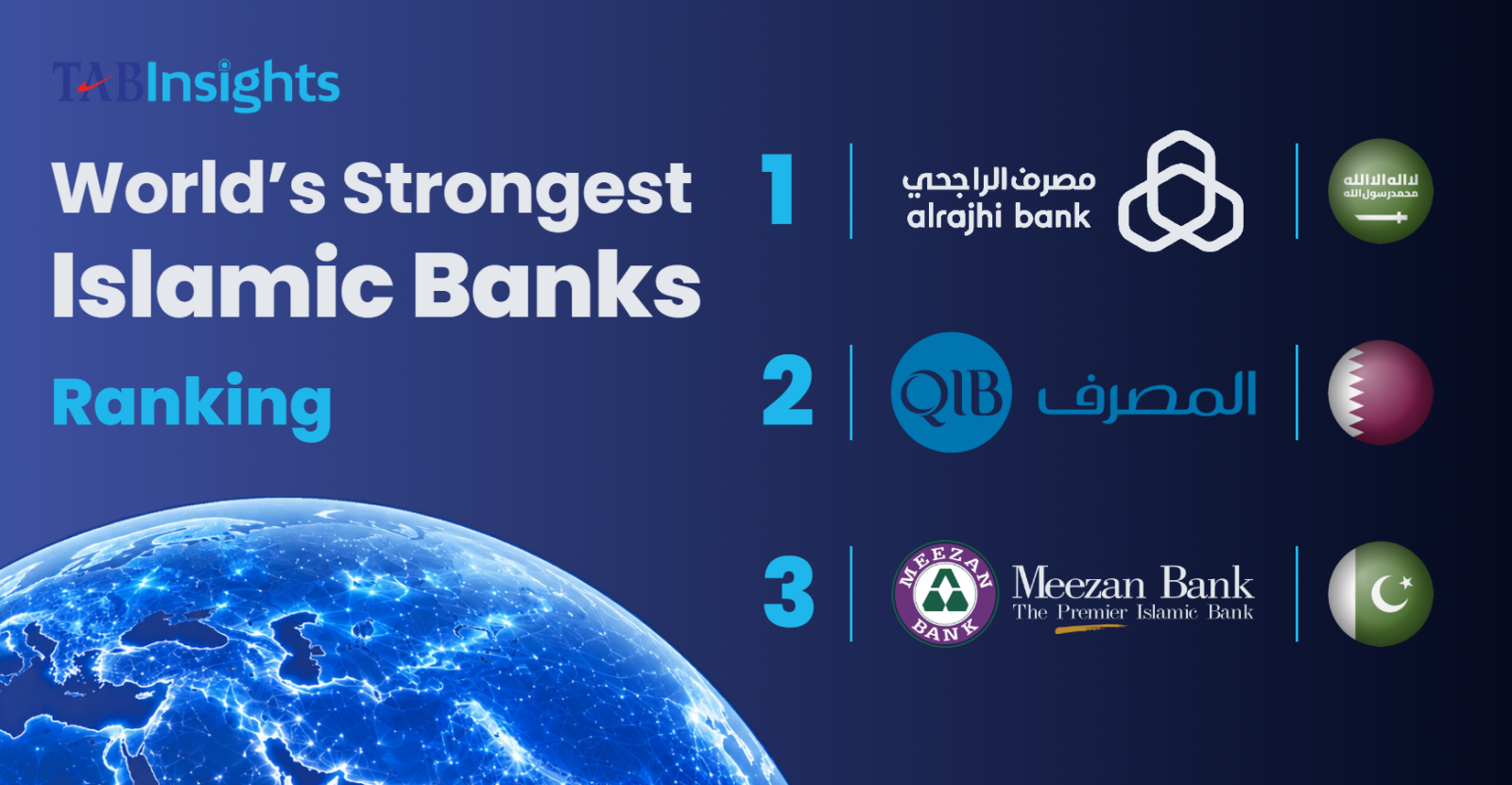
In this year’s Strongest Islamic Banks by Balance Sheet evaluation, Al Rajhi Bank remains the world’s strongest Islamic bank, followed by Qatar Islamic Bank and Meezan Bank. The evaluation uses a comprehensive and transparent scorecard assessing six areas of balance sheet performance—ability to scale
The TABInsights Islamic Banks Rankings highlight stronger financials in Middle Eastern banks, particularly in Saudi Arabia, Kuwait and the UAE, while Asian institutions remain smaller and less profitable. Islamic banks are strengthening balance sheets amid evolving risk and governance priorities.
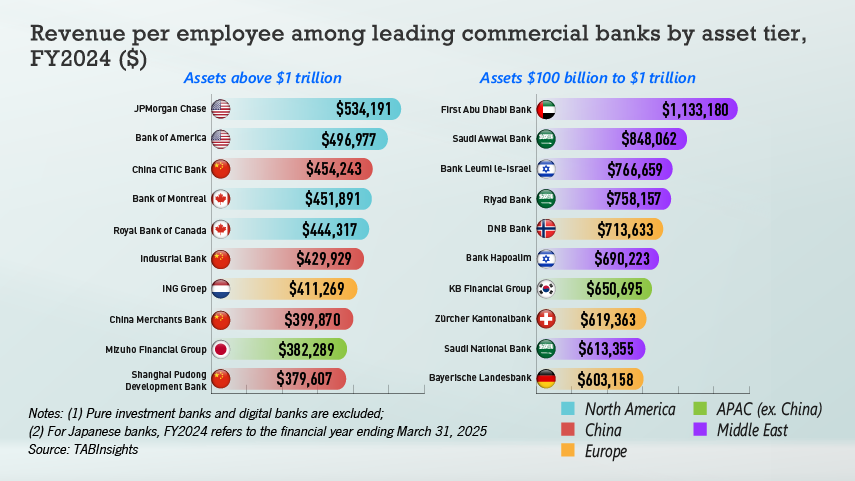
JPMorgan Chase and Bank of America lead large-bank revenue per employee rankings, while mid-tier banks such as First Abu Dhabi Bank and Saudi Awwal Bank report higher overall productivity levels, supported by focused business models, digital adoption and cost discipline.
Talk to our Middle Eastern team
We work with financial institutions, technology providers, asset managers, and regulators who need primary intelligence on the Middle East financial services industry — research grounded in direct institutional relationships and benchmarked against the global standards our assessment programmes establish each year.
Contact Graze Zhi at gzhi@tab.global to discuss your requirements. We will respond within two business days.








 Google
  LinkedIn