



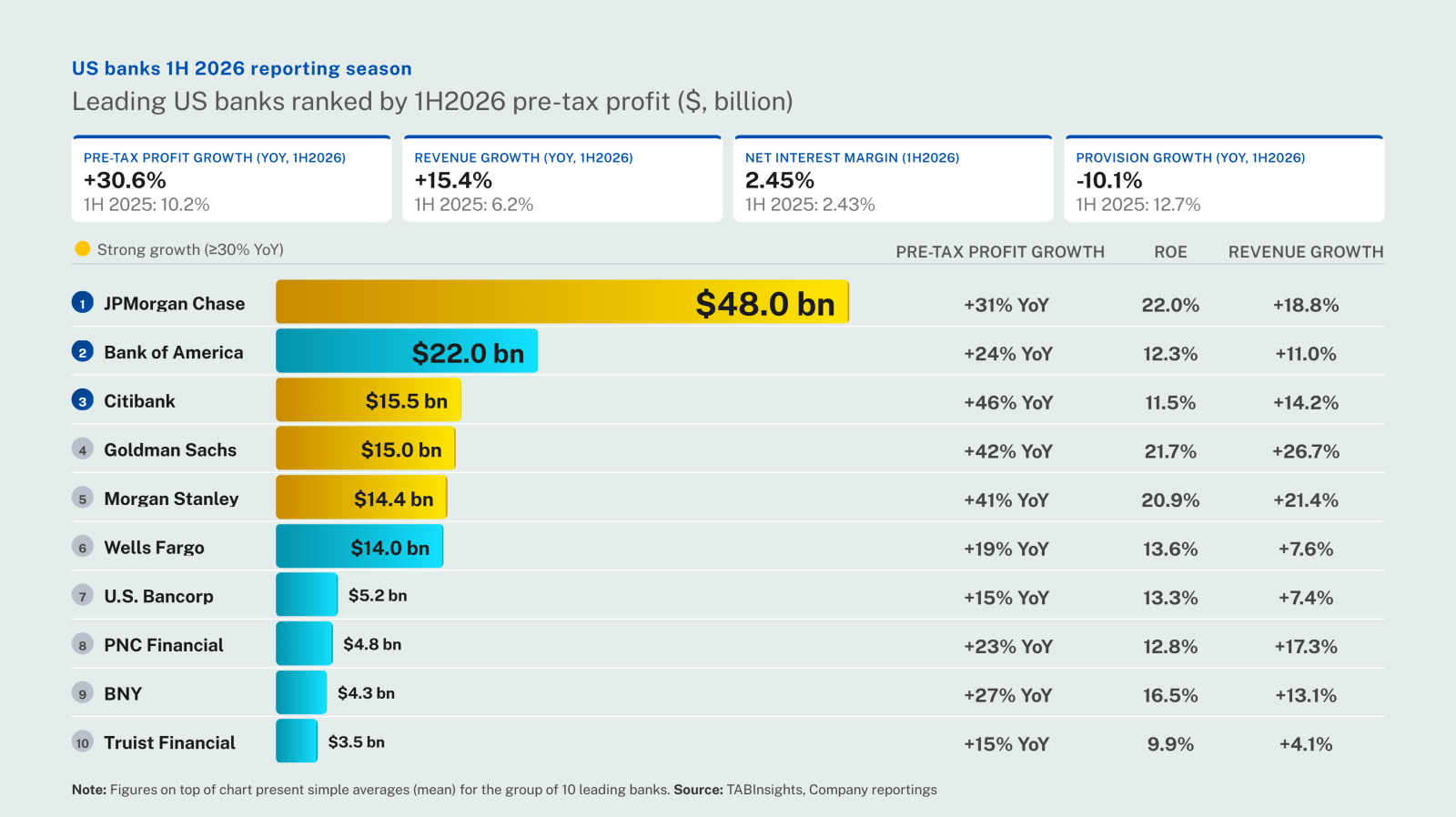

The combined pre-tax profit of 10 leading banks in the United States rose 31% year-on-year, from $112.3 billion in the first half of 2025 (1H25) to $146.7 billion in the first half of 2026 (1H26), according to company filings.
The increase reflected stronger capital markets and fee revenue, lower credit provisions and several material investment gains. Aggregate revenue advanced 15% to $391.5 billion as equity trading and investment banking benefited from higher market volumes, a reopening initial public offering market and financing demand associated with artificial intelligence infrastructure. Combined provisions for credit losses declined 10% to $18.2 billion, providing a further earnings tailwind.
By contrast, average net interest margin (NIM) edged up only two basis points to 2.45%, indicating that margin expansion was not the principal source of the earnings acceleration. Revenue growth was instead supported by fee-generating businesses, giving banks with substantial trading, investment-banking, payments and securities-services operations a broader earnings base than more rate-dependent regional lenders.
The economic backdrop remained supportive. US real gross domestic product (GDP) expanded at an annualised 2.1% in the first quarter, while the Federal Reserve ended the half with its target rate unchanged at 3.50%-3.75%. Lending and deposit growth remained resilient, but limited movement in average NIM showed that the earnings surge reflected operating leverage to capital markets activity more than a broad-based expansion in lending margins.
JPMorgan Chase produced the largest absolute profit and most clearly illustrated both the strength and composition of the rebound. Pre-tax profit rose 31% to $48.0 billion, while revenue increased 19% to $107.2 billion and return on equity (ROE) improved from 20% in 1H25 to 22% in 1H26. The increase was supported by strong capital-markets activity: second-quarter markets revenue rose 35%, driven by an 86% increase in equities trading, while investment-banking fees grew 30%. Reported profit was also amplified by a $4.6 billion gain related to Visa shares and another $1 billion of equity-investment gains recorded in the second quarter.
JPMorgan Chase chief executive Jamie Dimon said: “A rapid increase in revenue drives a big increase in operating leverage.” The results demonstrated how the bank’s scale and relatively fixed cost base converted stronger revenue into faster profit growth, although exceptional investment gains also amplified its reported performance.
Truist Financial best captured the constraints facing regional lenders. Its pre-tax profit increased 15% to $3.5 billion, while revenue rose only 4%, the lowest rate in the group. ROE improved from 8.1% in 1H25 to 9.9% in 1H26 but remained the lowest among the 10 banks, illustrating the continuing returns gap between Truist and the larger, more diversified institutions. Commenting on Truist’s latest results, chief executive Bill Rogers cited “disciplined execution against strategic priorities”, higher fee income and strong credit performance. The bank nevertheless reduced its full-year net interest income growth expectation as deposit mix and funding costs weighed on the outlook.
Caution accompanied the strong headline results. Citigroup chief executive Jane Fraser said conflict in the Middle East had weighed on global growth and given inflation “a second wind”, while Citigroup chief financial officer Gonzalo Luchetti pointed to normal second-half seasonality, particularly in markets revenue. Wells Fargo chief executive Charlie Scharf said businesses remained cautious despite strong balance sheets and warned that favourable economic and market conditions “do not go on forever”. Together, the comments underscored uncertainty over whether first-half capital-markets momentum and benign credit conditions could be sustained.
Second-half earnings momentum is likely to moderate as capital markets activity returns to more typical seasonal levels and the one-off gains that boosted first-half results are unlikely to be repeated at the same scale. The Federal Reserve’s June projections put 2026 GDP growth at 2.2% and the median year-end federal funds rate at 3.8%. Lending should remain supported by continued economic growth, but persistent funding costs may limit margin expansion. Diversified banks with substantial fee-generating businesses are therefore likely to retain an earnings advantage over more rate-dependent regional lenders.
Subscribe for regular insights.


Banner.png)



.png)






 Google
  LinkedIn