


Our archives on China

Datafiles May 05

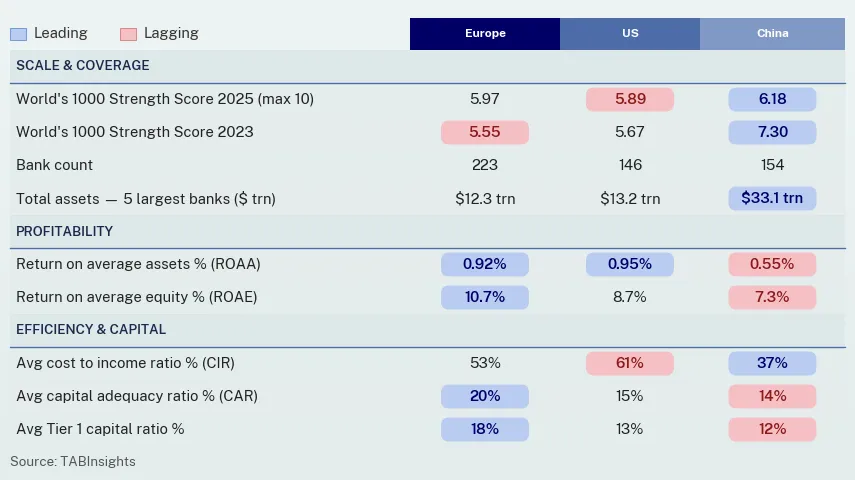
European banks have quietly closed the gap with their American rivals — and, on some measures of institutional strength, surpassed them, according to the World’s 1000 Strongest Bank Ranking. Yet Commerzbank, Germany’s third largest lender by asset size and strongest bank in Europe, illustrates why improved performance alone cannot substitute for structural reform: until the European banking union moves from ambition to architecture, Europe's gains will remain fragile.

Datafiles May 12

An analysis of AI initiatives across 29 Global Systemically Important Banks (G-SIBs) from 2023 to 2025 reveals a sector in structural transition: from experimentation to scaled enterprise execution, from point solutions to platform architectures, and from model access to data control and insights as the primary source of competitive strength. JPMorgan Chase’s decade-long institutional AI build illustrates what that transition looks like at the world's largest, most interconnected and systemically important banks.

Datafiles May 26

Digital banks with loan balances above $250 million are significantly more likely to be profitable, as scale and product diversification strengthen revenue. Most reach breakeven within three to six years. For those still unprofitable past the seven-year mark, N26 in Germany, Varo Bank in the US, Lunar Bank in Denmark and CIMB Bank Philippines among them, face an increasingly difficult case for continued investment.

Datafiles Jun 05

Mapping deposit growth against loan growth across the world's 1,000 largest banks reveals that 54% expanded lending faster than deposits between 2022 and 2024. When funding structures and liquidity buffers are also considered, Vietnam and Saudi Arabia emerge as the markets with the most vulnerable banking sectors. This underscores the structural challenge of building strong customer deposit franchises in high-growth emerging markets.

Exclusive benefits are on your way. Subscribe and enjoy the benefits.
Chat with us WhatsApp